
-
Standards and regulation
Standards
Trinity qualifications are assessed to the same standards worldwide. Our examiners are subject specialists who are regularly trained and standardised, and who work internationally to ensure the consistent application of assessment criteria and procedures. Our academic and operational staff oversee the running of exam sessions and have responsibility for the quality assurance of assessment processes, specifications and syllabuses.Regulation
Our work is scrutinised, monitored and reviewed by a number of UK regulatory authorities in order to maintain standards and confidence in qualifications. Trinity’s regulated qualifications are regulated by Ofqual (Office of Qualifications and Examinations Regulation) in England, CCEA (Council for the Curriculum, Examinations and Assessment) in Northern Ireland and by Qualifications Wales. Trinity is continually required to demonstrate compliance with the regulatory authorities’ Conditions of Recognition through a range of activities, including self-assessment, self-evaluation, submission of an Annual Statement of Compliance and audit.The Regulated Qualifications Framework
All of Trinity’s regulated qualifications meet the requirements of the Regulated Qualifications Framework. Ofqual, CCEA and Qualifications Wales introduced the Regulated Qualifications Framework (RQF) to replace the previous Qualifications and Credit Framework (QCF) and National Qualifications Framework (NQF). -
Music qualifications recognition

UCAS points
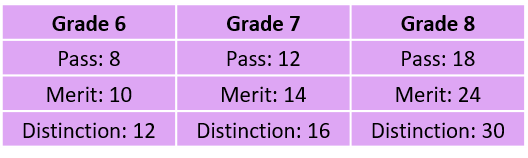
Trinity College London’s Level 3 qualifications (Grades 6-8) in music performance and theory are included in the UK Universities and Colleges Admissions Service (UCAS) tariff, and attract UCAS points for university and higher education entry.UCAS has introduced a revised points tariff for courses starting from September 2017 onwards.For students applying for courses starting in the 2017/18 academic year or later, the following points apply:Practical (Classical and Jazz, Rock & Pop)
The following applies both to face-to-face and digital grades.
Theory
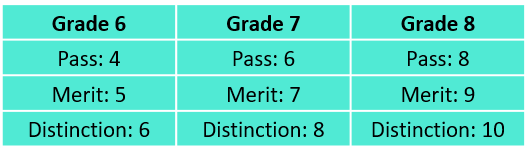
The points listed above relate to the new UCAS tariff points system, which will apply to university and college courses starting from September 2017 onwards. Please note that the number of UCAS points awarded to all qualifications has changed, including A levels, AS levels and Trinity qualifications. For example, an A* at A level was worth 140 points under the old UCAS tariff, but will be worth 56 points under the new system. Further information is available at www.ucas.com
-
Prerequisites
Music graded exam
Candidates may be entered for an exam at any age. The candidate’s date of birth must be stated on the online enrolment form.Music Performance Diploma exam
Candidates may be entered for an exam at any age. The candidate’s date of birth must be stated on the online enrolment form.There are no prerequisites for ATCL or LTCL.
The prerequisite for FTCL is LTCL in the same instrument. Candidates who have passed LTCL should indicate this in the appropriate place on the entry form. Candidates wishing to take FTCL who do not have an LTCL may substitute an equivalent qualification, or offer prior learning at a similar level. Any substitute qualification or prior learning must be approved by Trinity. Examples of alternative qualifications accepted in place of LTCL include:
◗ ARCM, ARNCM, LGSMD(P), LMusA, LRAM, LRSM, LLCM diplomas in performance, in the same instrument
◗ Other performance diplomas of graduate status, eg GTCL, GRSM, in the same instrument
◗ BA (with performance) or BMus from a conservatoire, eg Trinity Laban, or from a university, in the same instrumentApplications for approval of substitute qualifications or prior learning must be sent to music@trinitycollege.com at least six weeks before the closing date for entries at the chosen exam centre. Applicants should attach as much evidence as possible of learning gained. This may include transcripts, syllabuses, concert programmes, references, etc. Each case will be considered on its individual merits. If the application is approved, Trinity will supply a reference number which must be quoted on the entry form.
Candidates may not enter for an exam until they have received this reference number; provisional and conditional entries cannot be accepted.
Rock & Pop exam
Candidates may be entered for an exam at any age. The candidate’s date of birth must be stated on the online enrolment form.Music Theory exam
Candidates may be entered for an exam at any age. The candidate’s date of birth must be stated on the online enrolment form.There are no prerequisites AMusTCL
The prerequisites for LMusTCL are AMusTCL or Trinity Grade 8 Music Theory
-
Introduction and overlap of syllabuses
We update our syllabuses from time to time. Advance notice of any changes will be announced officially at www.trinitycollege.com.hk
Details of overlap period can be found in different exam syllabus accordingly. -
Applicant’s role and responsibilities
– The applicant’s responsibilities are: to comply with these Exam Regulations, making sure that those connected with the exam (including the candidate) are aware of relevant matters; to make sure, where a candidate is under the age of 18, that one of the candidate’s parents (or someone else with parental responsibility) has consented to their child being entered for an exam; to submit the exam booking, making sure that the information in the booking is accurate, including name spellings, exam subjects and levels, and any specific needs; to pay for the exam; to make sure the candidate is aware of the exam date, time and venue; to receive the exam result/certificate and to pass them on to the candidate.
– While the applicant is our main point of contact in all matters, we may share information about an exam with another party, including the candidate and his or her parents (or those with parental responsibility), in response to a valid question. At the time of booking, the applicant will have the option to add an email address for each candidate, allowing them to set up an account. Providing email addresses is compulsory for Performance Grades and online Music Theory. With an account, candidates (and their parents/carers) can go online to view exam information, change appointments (where possible) and access their results and exam mark forms. The candidate will receive emails about their appointments and results after the applicant. Candidates and parents/carers can set up an account at any time as long as they know their Contact ID.
– We cannot become involved in any dispute or communication breakdown between an applicant and the candidate or his or her parents (or those with parental responsibility).
– We do not verify the degrees or qualifications of applicants which may appear on ABRSM certificates. Applicants are expected to provide accurate information when making bookings. g. For candidates under the age of 18 taking Performance Grades, ARSM or Music Theory exams by digital assessment, it is the responsibility of the Applicant to inform the parent/carer that the exam will be video-recorded for assessment, compliance and safeguarding purposes. Consent for the candidate to be recorded must be given by the parent/carer before making an exam booking.